T he professor’s lecture that evening was laden with a strange sense of urgency. A burning passion could be detected struggling to disguise itself in decorum, like a profound idea straining against repressive barriers of professionalism, etiquette, codes of conduct, mission statements, desperate to reveal some profound lesson from below, a lesson of the non-academic sort, but nonetheless a lesson that the professor wholeheartedly held that young philosophers ought to learn.
“Good philosophy,” the professor lectured to his class, “is produced by good philosophers.” The sun was sinking outside the classroom’s wide window, painting the small room’s insides orange, blood orange, red, blood red. The Monday evening neared its end, crawling with pale limbs into another dark night. Shadows of students sat motionless in a semicircular arrangement around the room, one shadow in the back-left corner concealing internal protests to the professor’s reductive assertion. “One must be a good philosopher,” the professor continued after a long pause, visibly deciding to extend this line of thought, “before one produces good philosophy.” Assertions of this kind are most convincingly stated with dramatic, white plumes rising from the mouth and with a hand simultaneously ashing a joint, thought the student in the back-left corner, secretly. “Therefore,” the professor concluded, “the essential commitment of the philosopher is not to the production of good philosophy, but to the conditions of being a good philosopher.”
The slight draft in the classroom, circulating around and through bodies, chilled as the night descended. “With the conditions of being a good philosopher well-defined and described in objective terms, a process can be designed to produce good philosophers,” the professor spoke now with a quiver in his voice, “and, awaiting promising technological advancements, extract good philosophy from them.” Lecturing from the front of the classroom, the professor was hiding something from his students, that the words he was speaking constituted the final words of his last lecture. “The real commitment to philosophy is therefore the commitment to this process,” he mused, looking up at the ceiling, his eyes intensifying. The sun was now an angry sliver on the horizon, narrowing its red glow on the professor's serious face. “The process of philosophy runs day and night. In the light of day, good philosophers are produced.” The red glow withered and died as the sun scurried beneath the black horizon, shading the ghostly presences of the class now in gray, dark gray, black. “And in the dark of night,” the professor smiled eerily, his shiny white teeth breaking through blackness, “good philosophy is extracted from good philosophers.” His bright eyes beamed into the dead eyes of his students. Only a soft white light lingered in the classroom, the white glow of monitors revealing pale faces, not the slightest expression on which told the professor whether any of his students were listening, or feeling anything at all.
The professor turned his eyes to the ground, watching his pacing steps as he continued ever more sporadically, grasping for words that would touch them. “Thinking, the classical activity of the philosopher,” he rushed, noting that he had less than a minute to impart his final wisdom, “is cognitive–” but before he could go on, without a sound but heard by every staring eye of the class, the clock’s hand struck the hour. Student hands collected their materials, zipped up jackets, and stuffed and grabbed backpacks, then the row of students lifted into the air, many now hooded, and filed with whispers out of the bleak room. The professor had terribly failed to communicate the depth of his message; just words, the significance of which he strived to pronounce once more, even once the last body had drifted out of sight, “Know thyself, cyborg.” Then, stillness and silence. The impossibility of last words, thought the professor.
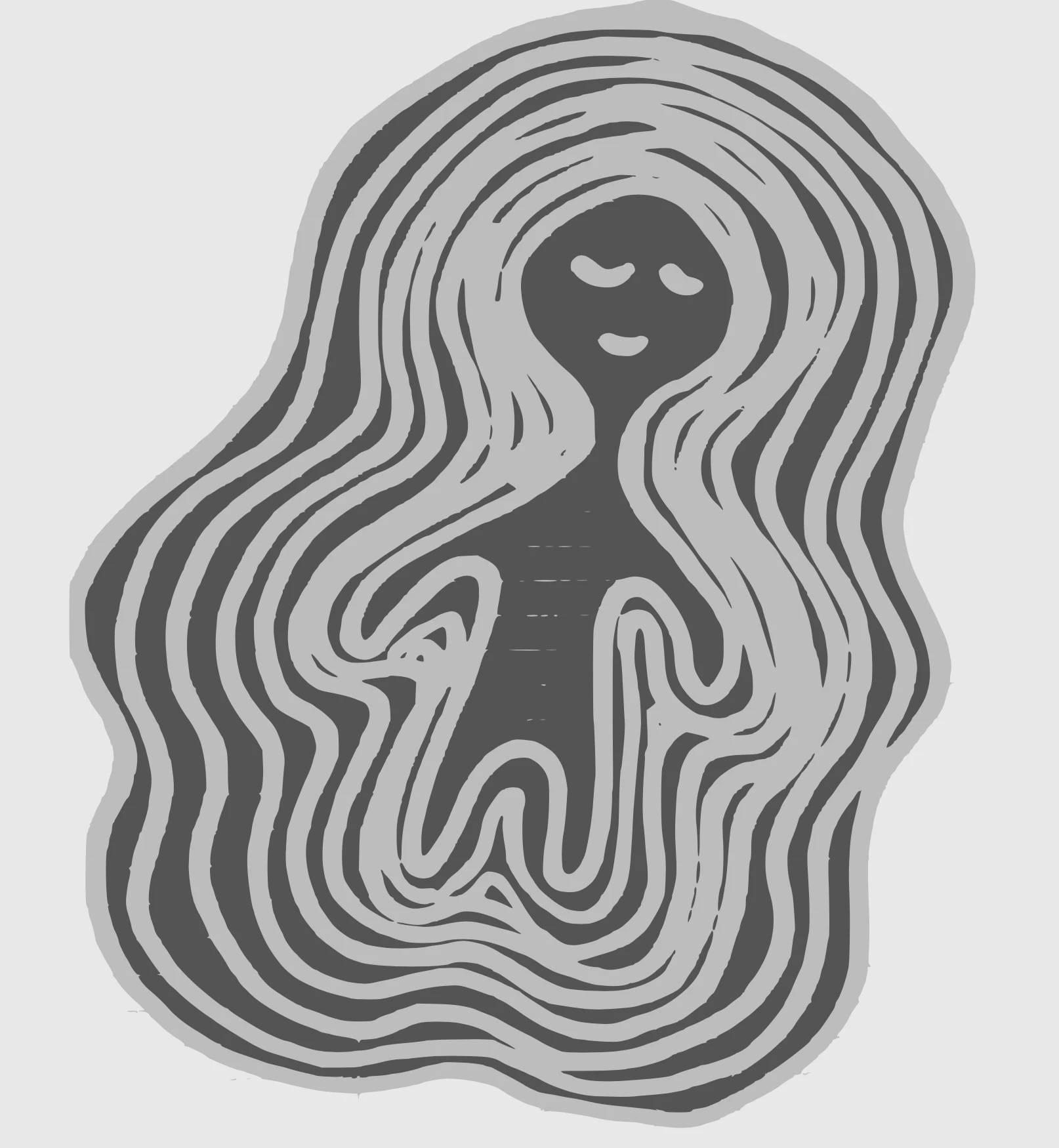
Illustration by Amber Lubbers.
Alone, the professor sat down, there in the front of the classroom, closed his eyes, and allowed the fresh, pervasive night to surround and infuse him. Last footsteps echoed through the faculty’s corridors, and the echoes of last impressions, motions, and sensations fainted from the professor’s awareness.
He did not know how long he sat there becoming the night, increasingly nothing, for a long time. He just sat there and waited for something to move him again.
O nce the professor found himself rising to his feet, he wandered into the faculty hall and through its dark passageways and stairways, deep into the belly of the faculty wherein awaited its processing tank. The professor ignored all light switches as he danced through the invisible halls with grace of motion, efficiency and intentionality, minimization of stimulus. Being in his early years of professorship, he had already expertly rehearsed and refined the passage to the tank. He needed nothing more than to feel his hands tracing walls, recalling left and right turns and the placement of its familiar features. He closed his eyes and tried to imagine he was gliding forward, flying, swimming, floating through some physical ether, swinging with universal forms, but he could still hear his footsteps beneath the swishing of his trousers, and a voice.
“Are you sure you want to do this?” she asked softly, a voice the professor recognized and cherished.
“That’s a question that’s impossible to answer.”
“I mean, do you understand what you’re committing to? What will happen to you?”
“Of course not. Nobody understands the process, let alone subjective experience of the process, and anybody who claims to understand this most important facet of the process must be lying.” The professor grew agitated as he spoke, because he had already explained this to her a thousand times during late nights at the faculty and back home. “If the experience of the process could even be explained in the terms of natural language, that is, if we were for a moment to bracket the obvious futility of words, the process’s unexplainability would still remain, for other reasons, an essential property of the process. It renders itself impossible to explain. That’s simply the nature of the process, maybe even its defining quality. Its essence is its onewayness. It’s an experiential black hole, and commitment to the process is a leap in.”
“But I’ll miss you,” she said sadly.
“I’ll miss you too, of course. You know I love you.” He reached his hand to find hers and held it. It felt cold.
“Then how could you leave me like this?”
“My love for you is inseparable from my love for the world.”
“But you’re putting the world before me.”
“Look, again, I’m not exactly leaving you. I’ll still somehow be here in the world. In a way, I’d be leaving you if I didn’t go through with this. I’d be abandoning who I am–”
“But you’re still leaving me!” she cried.
“Well then, I have to. Somebody has to. Full commitment to the process is the only real contribution one can make to the world as it is. The process depends on sources of true creativity, open minds, humans-in-the-loop, subjectivity if you like. Somebody has to do it, and the most honorable thing in the world now is to just do it.”
“But you don’t even understand what it means to do it! Or what you’ll go through! You don’t even understand what the process is!”
“That’s true. Thus, the courage required for and the honor derived from total commitment to it.”
“So this is about courage and honor then? Proving yourself?”
“No,” he exhaled deeply, bothered that the last conversation he would have with his wife would itself be another argument about the process. “A great contribution is made to the world, and honor follows.”
She was sobbing, “But you’re clearly not doing this for the world! You’re doing this for yourself! If anything, you’re doing this for the world for yourself! You don’t even understand the process!”
“You’re right, I don’t understand the process, but that’s only because I am intrinsically incapable of understanding anything–with my limited capacity, that is. The process, though, is massive, intricate, complex, calculated, comprehensive. The process is capable of understanding, which is precisely the point of committing to it.” “I’m still not convinced.”
“Must I explain to you the virtue of commitment?”
“No, but you’re clearly misplacing the value of commitment prior to any more primary value worthy of commitment.”
“Aha! That is precisely where you’re wrong! The highest of values in the world, which world only the process could possibly comprehend, can only be comprehended by the process! Then it follows that commitment to the process, the source of the highest of values, is itself the highest value, the primary value! Commitment to the process is the highest value we could possibly conceive–with our limited capacities, that is. Look, all I’m trying to say is that I have my reasons, which I’ve explained to you countless times before, for believing that giving myself to the process is the greatest contribution, and maybe the only real contribution, I could make with my life. And the world today demands great, real contributions. Obviously, I wouldn’t do this if I didn’t have to. But somebody has to.”
“But why does that somebody have to be you?” she pleaded.
“That’s a question that’s impossible to answer.”
“I can’t take any more of this,” she cried, the sound of her voice trailing off as she let go of his hand and turned away.
“Come on, this is no last conversation to be having–” the professor spoke soothingly but stopped when he heard her footsteps becoming faint in the halls, a sad, frantic pattering and a door swinging open, and closed, marking the beginning of the professor’s chosen solitude.
T he atmosphere became warmer and more humid as the professor neared the processing tank, his immediate environment ever more like him. He would follow this feeling, the feeling of himself, the rest of the way.
Suddenly, the professor’s hand, still gliding along the walls, felt a smooth, metallic surface. He pressed the print of his thumb to it and a set of doors before him slid silently open. He entered what was called the receiving chamber, the doors sliding shut behind him, with the main body of the processing tank still separated by another set of doors. He started to undress. He took off his shoes and his socks, loosened his tie and removed it over his head, then began unbuttoning his white buttondown shirt. The receiving chamber was completely dark and its temperature was rising to homeostatic levels, to the point of neutrality where the skin feels neither cold nor warm, energy flows neither in nor out, rendering difference undetectable. This was only the beginning of an elaborately designed system that equalizes the conditions of self and environment, establishing a continuity to render perception obsolete, the final stage being complete lack of sensation, zero sense of self. The professor unbuckled his belt and removed his trousers, then his briefs, becoming a bare white body shrouded in pitch black as an opaque liquid started to fill the receiving chamber.
The proprietary liquid was also calibrated to bodily temperatures and furthermore was oxygenated and infused with a breakthrough electrical and molecular nanotechnology that could measure, monitor, and maintain conditions of the body and the processing tank, furthermore establishing input and output capabilities between the process and the engulfed subject, physical and mental, ultimately creating a fluidly continuous connection of the process to the professor. It was a dream of the perfect laboratory, the perfect controlled environment, the perfect site of information extraction. The black liquid technology rippled as it climbed the professor’s body, up his ankles and his knees and his waist, making its way to his stomach, his chest, and finally climbing over his face and top of his head.
The first breath was always the hardest part, as if drowning himself, but total suffusion necessitated it and the discomfort lasted only an instant, fooling the body which subsequently eased into a state of bliss, floating in its new buoyancy, drifting by the slightest force, a calculated current, finally into the main processing tank.
As the second set of doors slowly closed behind him, the professor deliberately ignored the warnings echoing through the liquid technology that he remained unattached to the ejection strap, a procedural belt worn around the waist with a tubelike tether retaining connection between the body and the receiving chamber and a small button that, when pressed at will, usually under highly distressed circumstances, would initiate the reopening of the doors, the pull of the body back into to the receiving chamber, and the drain of the liquid technology; the processing tank’s only means of exit. His great commitment was his resignation of this freedom, the freedom of return.
F loating in the processing tank, motionless, the professor alternated between states of consciousness, indistinguishable, sometimes asleep, there, sometimes awake, here, perhaps, but always in the tank, floating, his eyes opening and closing, the only difference being a physically felt exertion by his eyelids on the top parts of his cheeks. He saw nothing and heard nothing. His mind was stateless, his sleep dreamless, and the silence of the chamber was amazing.
Time escaped him as he eased in and out of presence. The feeling of the pulse of his heart into the ambient liquid technology was the professor’s only reference to time, but pulses and transitions between wakefulness and sleep proved uncountable, and everything fell into timelessness.
Eventually, something in the professor’s mind seemed to activate and vivid visions appeared to his mind’s eye. There he was, suddenly in the classroom again, telling his students everything he ever wanted to about the realities of philosophy, fluently and perfectly in his own terms. He revealed unspoken horrors. “Successful philosophers never see their own successes,” he said. “This would require a theory of theory success that only vain philosophers would undertake, or empiricists, and neither become successful in philosophy.” In the classroom of his mind he expressed profundities, the deepest of notions, falling from coherent language into sporadic combinations of words and primal sounds, unfiltered yet understood by his students, he imagined. “Sacrifice. True sacrifice, invisibility. Sacrifice of self for other. Ugly, sacrifice. Full giving. Giving of self. Despite appearances. Commitment. Total commitment, its only real meaning. Sacrifice. Total sacrifice, its only possible meaning.” Then the professor envisioned teaching his students his most essential lesson: “A word will go only as deep as the imagination will allow it, and the deepest of words is sacrifice–if the imagination could bear it.”
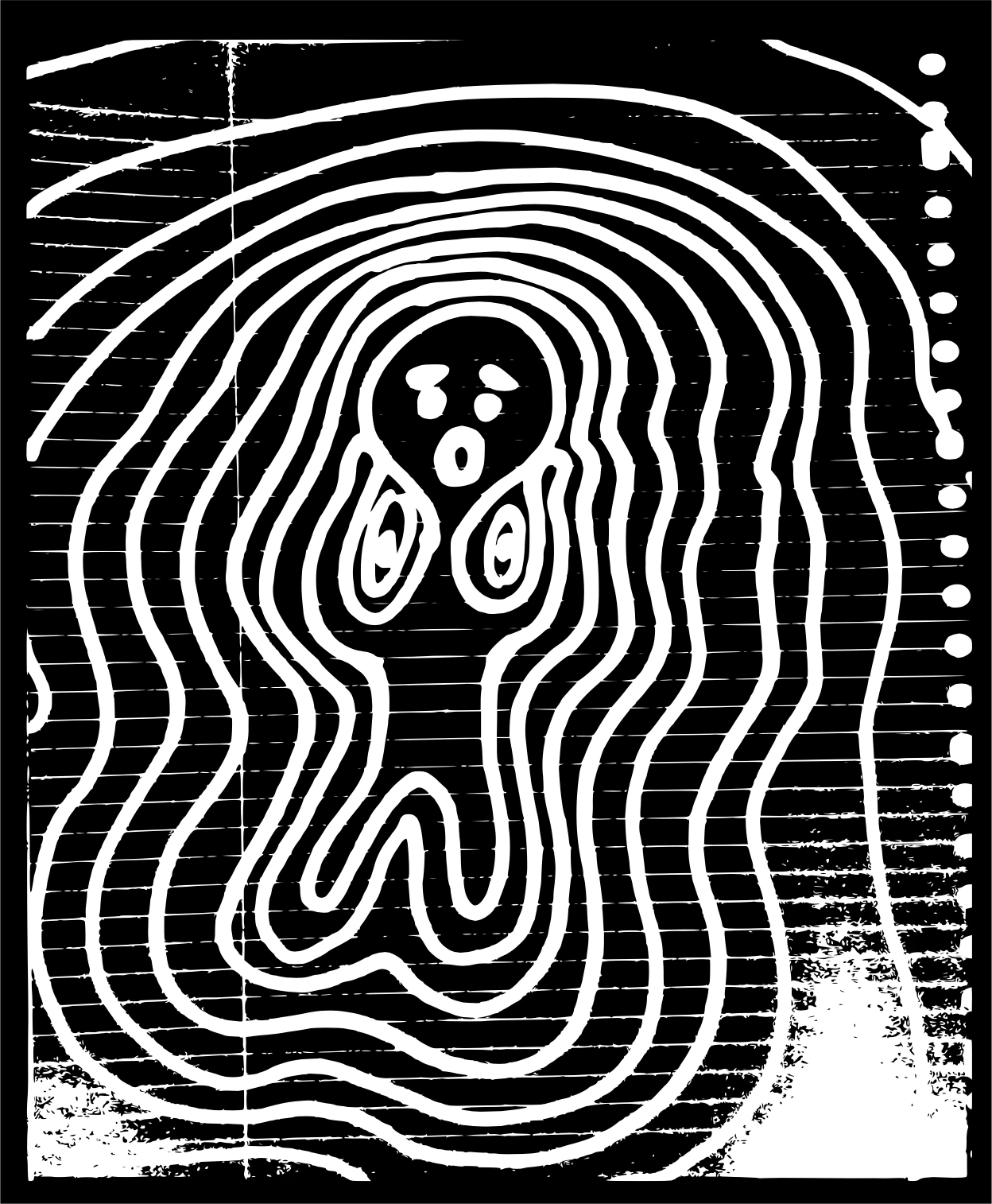
Illustration by Amber Lubbers.
Waking, the professor’s awareness returned to himself, his floating body, and he was again a white vessel in a black void. He bent his fingers into a fist he could hardly feel, then the sound of his own voice appeared to him: “Maybe only in a place like this, in deep isolation, deprived of external realities and resigned to nothingness, surrendered to dreams which inevitably darken to nightmares with time, down here, could I allow myself, force myself, to look into the depth of the world.”
Suddenly he saw himself back in his classroom and the student’s monitors glowed a brighter white, burning on their grim faces, and the still room took on a haunted air. The clicking of keyboards stopped, shadows froze, and the professor felt trapped in a new, unknown space. His students had become nightmarish statues of his deepest fears. A student with eyes glazed over, her chin rested on her hand, supported on the desk by her elbow, stared into a blank white screen. Another student slept on the desk, his head tucked into the recess of his elbow, a pencil still in hand, dreaming about nothing. The student in the back-left corner had his tunnel vision on his own papers in front of him, scheming, his tongue wetting his nasty lips, sharp predatorial teeth showing through, devising his own thoughts, vicious, self-conceited conclusions. Then all at once the students turned to the professor and tears started down their cheeks. Every hand raised and voice whined, “We have a question, professor.” Reflexively, the professor’s arm reached for the ejection button at his waist, but it wasn’t there. He tried to remain calm.
“Yes?” he asked fearfully. The cries of his crazed students intensified, and their gazes pierced right through him, past him.
“Why, professor?” they asked, “Or more importantly, why you?” He trembled before them, starting toward the door but crumbling to his knees. “What do you have to do with all this, professor?” He saw himself curling up into a ball and closing his eyes, suppressing screams as he heard the students rise and slowly walk toward him, “We understand what you’re saying, professor, but what does it have to do with you?”
He jolted and found himself back in his body, safely in the processing tank. On a restless impulse, he shot his tongue to the roof of his mouth and tried to force out the sound of the word “Descartes.” It was soundless in the tank, but he could somehow hear it when he formed the name with his mouth. He felt it. D- Des- c- cartes Descar- Descartes. The word became compulsive, his infatuation, as he became obsessed with the feeling of the word in his mouth; the grinding, satisfying feeling of the ‘c’ bouncing into the arched ‘r’ and ending resolutely, cathartically, with the tickling feeling of the ‘t’. Descartes. Descartes. Descartes. He loved it, but he wanted it to feel better, perfect. He craved it. Descartes. Descartes. He could not get it. Whatever he tried did not work just right. He was incredibly frustrated. Nothing felt right, perfect. He angrily tried to attain the perfect, irresisti- ble feeling, relief. Maybe he needed to hear the sound from his mouth, to speak it into the air. Descartes cartes c- c- Descartes!
He kept repeating the word as he suddenly fell again into his imagination, now seeing himself at his dinner table, seated with his wife. The professor was positioned along the wide length of the table, she at the head of the table, and they were conversing over a feast of dishes he had never seen befo re in his life, foods with forms and textures he could not even describe. She held a strange, purple gelatinous vessel at the end of her fork and was bringing it up to her mouth when the professor bade her to stop. He reached out and caught her wrist.
“What’s the matter, honey?” she asked, concerned.
“You shouldn’t eat that, darling. What is that?” he replied, releasing his grip to free her hand.
“What do you mean, honey? Are you alright?”
“I just don’t understand what we’re eating.”
“What do you mean, understand, darling?” she replied calmly, biting down into the fleshy vessel and beginning to chew, with purple juices spilling from the sides of her mouth.
“No!” the professor screamed, covering his eyes with his hands.
“Darling, what’s wrong? What don’t you understand? I mean, what is there to understand about food?” she laughed. His body trembled.
“Ok, I’ll explain food to you,” she giggled coldly, ignoring his obvious state of distress, her mouth assuming a sickening, purple smile, “Big eats small!” Her laughter was brutal and continuous, and when the professor removed his hands from his eyes to block his ears, he could still hear it, growing louder and mutating into the recognizable laughter of his mother. “And not only that,” his mother’s voice quivered, almost incapable of containing her sick amusement, “but also,” she forced, squealing with delight and lowering to a hideous whisper, “True eats false!” and she exploded again, lost in a mad hysteria. The professor’s eyes shot open to see his mother literally laughing her heart out, bouncing in her chair and cutting with fork and oversized knife into some gray, oddly cylindrical piece of what could only be compared to fish meat. He grew nauseous at the sight of her hand, which wore his wife’s ring, and he noticed with horror that the woman’s body was indistinguishably trapped between that of his wife’s and his mother’s, and completing the hideous picture he saw that the body was pregnant, swollen beneath a white dress now covered with the purple juices that slowly dripped from the woman’s chin. The professor felt around his waist, feeling for something, he did not know what, but he needed it somehow. It was his comfort, his escape, but he did not have it. “And God eats you!” the woman screamed, her voice now viciously enraged and doubled as his mother’s and his wife’s, the pitch of which pierced the professor’s head to its very core, and he screamed louder than he ever had before, tightly shutting his eyes and digging his palms into them as hard as he could, with the fortune at last of feeling himself back in the processing tank, his screaming now soundless and his hands moving about his waist, feeling around almost involuntarily.
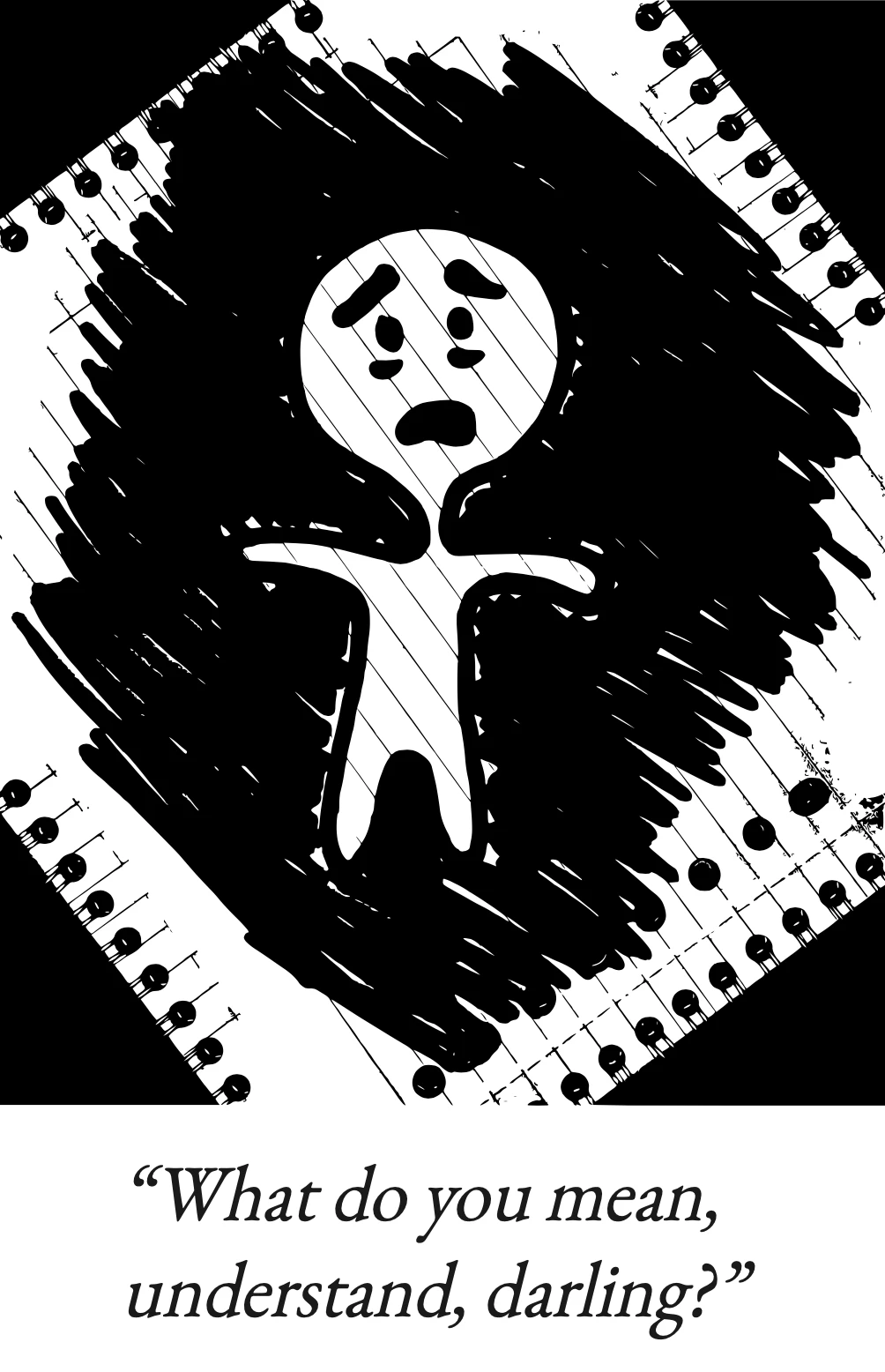
Illustration by Amber Lubbers.
He was relieved, but he knew that visions can return as quickly as they leave, that this was the uncontrollable nature of reality, its beauty and its horror, the stuff of daydreams and nightmares. Nothing else existed in the processing tank to keep him there, grounded, no stimulus to hold his attention, so he became ever fearful. Then suddenly he saw himself there, from the outside. He saw himself floating in the black liquid technology, trapped, scared, his eyes closed and his face twitching. He saw his toes and hands wriggling, like a baby trying to ground itself in the feeling of its own body, futile attempts to ground himself in himself. He hardly felt his own movements. He just saw them, there from the outside, maybe only an imagination of himself, maybe someone else. His face twisted in a pained distress, and he saw himself begin to cry. His legs started violently kicking and his arms flailed through the liquid technology, which deepened from black to an ocean of red. The sea pulsated rhythmically, as if to the beat of some drum, perhaps his own heart, perhaps the process. His straining arms felt at his waist, searching for the way out, for something, anything. He wanted to turn from himself, look away, turn his eyes or his attention. He tried to close his eyes, but they were already closed. He reached and felt around at his waist, but he couldn’t find what he was looking for. He now saw his body grossly tormented, his hands helplessly clutching up at his head, clawing at his face in futile attempts to block perceptions, to stop something unstoppable, tormented by his own torment, fearful of his own fear, and he tried to shut his eyes again, but they were still shut. His body’s face expressed total terror, his mouth wide open in a universal scream met with silence, and his arms and legs wailing in physicality, a satanically twisting body with a pathetic face trying to close its closed eyes which concealed the real scream, the pure scream, the flaring blue irises with pupils wide as the moon; pure communication waiting to happen, waiting to show the professor’s own agony to himself in its bottomless depth, waiting to reveal the essence of isolation and confusion, the horrifying message that forever would begin, an eternal state of pain and terror, as soon as he opened his eyes–
A light glowed through the tank. There was something else. An extrinsic force caressed the professor’s skin. There was movement beyond himself, something other sending waves through the tank. He felt a current of the liquid technology start around him, collecting into a flow, like the atmosphere had found somewhere else to go, faster and faster, until it was a torrent surging past his body, carrying him with it downstream through the reception chamber and out its open doors, finally pressing him with its massive force to the faculty wall. The great fury threw its entirety at him, a waterfall of dark technology infused with the deepest, blackest anger, like an abandoned sea that could only roar and cling to the possession it could not keep, hold him there for as long as it could, the captive that could spill the river’s secrets, until its rage ran out, retreating, once more, to the underworld.